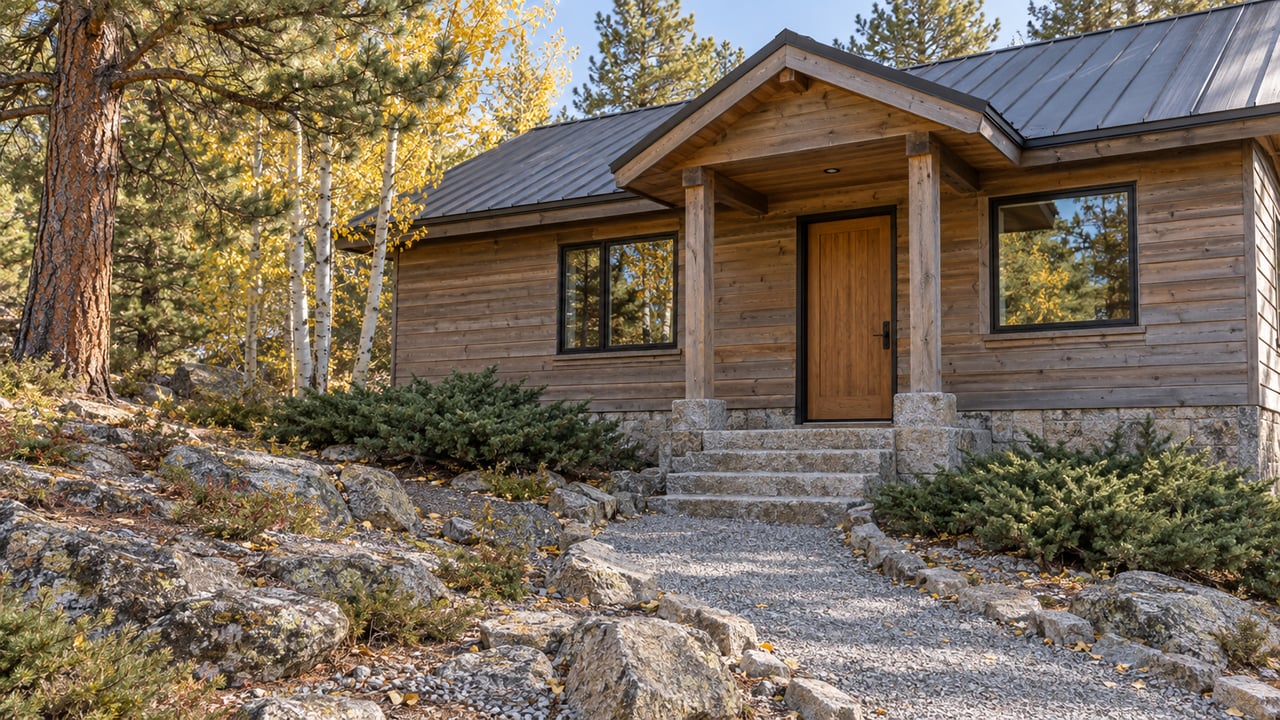
A cabin along Big Thompson Canyon Road can look like a steal on paper. The price per square foot lines up with what you'd expect to pay in Estes Park or Glen Haven, the photos show pine trees and river frontage, and the listing feels like the deal you've been waiting for. Then underwriting starts, the flood insurance quote arrives, and the math on the deal changes before you've even made it to closing.
That sequence is common enough in Drake that it's worth understanding before you start comparing this canyon hamlet to anywhere else in the Estes Valley. The headline numbers here (a median list price hovering in the $490,000s to $520,000s and a price per square foot in the $340 to $380 range as of mid-2026) don't measure the same thing they measure in a normal market. Drake's numbers are shaped by a floodplain, a rebuilt highway, and an inventory so small that a handful of sales can swing the average by double digits.
The Insurance Line Nobody Puts in the Listing
Drake sits inside Big Thompson Canyon, where the river has flooded twice in living memory: once in 1976, when a wall of water more than 20 feet high killed 144 people and destroyed 418 homes along the canyon, and again in 2013, when storms washed out sections of the highway and cut the corridor off from Loveland and Estes Park for roughly two and a half months. Neither flood is ancient history to the people who own property here now. It's why so much of the canyon carries a Special Flood Hazard Area designation.
The Colorado Division of Insurance says most NFIP coverage carries a 30-day waiting period before it takes effect, which means a buyer who waits until the week before closing to get a quote is cutting it close. The Colorado Water Conservation Board has also noted that more than 20 percent of flood insurance claims nationally come from properties outside the mapped high-risk zones, so a parcel that reads as low-risk on the map isn't automatically free of the conversation. If you're shopping in Drake, get a flood zone determination and an insurance quote before you write the offer, not after.
Why the Road Rebuild Still Matters When You're Reading a Listing
The highway that gets you to any of these properties has its own history worth knowing. After the 2013 flood destroyed more than 10 miles of the US 34 roadway embankment through the canyon, Colorado's transportation department didn't just patch the damage. It rebuilt 23 miles of the highway with the explicit goal of keeping the corridor passable during the next major storm, including moving the roadway at the notorious horseshoe curve from the outside of the river bend, where the 2013 flood had washed it out completely, to the inside, so the river has room to run without taking the road with it.
That project finished years ago and the highway has carried normal two-way traffic since. It matters for a buyer today because it's part of what you're actually pricing when you buy in Drake. A canyon that has already been engineered for resilience after two catastrophic floods is a different risk profile than one that hasn't, and that history is baked into insurance underwriting even when it never appears in a listing description.
The Square-Foot Trap: Drake Isn't Building the Same House as the Rest of the County
Here's the number that changes how you should read every other number in this market. Multiple MLS-fed sources put Drake's average home size somewhere between about 1,540 and 1,710 square feet, while the Larimer County average sits between roughly 2,530 and 2,640 square feet.
| Typical size | |
|---|---|
| Drake average home | ~1,540 to 1,710 sq ft |
| Larimer County average home | ~2,530 to 2,640 sq ft |
That's not a small gap. Drake's average home runs roughly a third smaller than the county norm. So when a Drake listing quotes $340 or $380 a square foot, matching a similar rate in Estes Park or Glen Haven, you're not necessarily buying a comparable house. You may be buying a smaller cabin at a rate that only looks equivalent because the total square footage underneath it is smaller too. Compare total livable space and total price, not just the rate per foot, or you'll end up anchored to a number that describes a different kind of house than the one you're standing in.
The Listing Count Tells You How Thin This Market Really Is
Count active Drake listings across different portals on the same week in 2026 and you'll get answers ranging from the high 20s to the high 40s, depending on which feed you're looking at and how it handles vacant land. That spread isn't a data error. It's a reflection of how small this market actually is. A hamlet with under fifty active listings at any given time doesn't behave like a market with thousands of transactions smoothing out the noise. A few sales closing or falling through in the same month can move the median and the price-per-square-foot average by a meaningful percentage.
Part of what widens that spread is that raw acreage gets counted right alongside built cabins. It's common to see vacant land along Big Thompson Canyon Road listed for sale in the same pool as finished homes, sometimes with price tags in the low $200,000s for land with no structure on it at all. Land doesn't have a square footage to divide the price by, so when a portal folds those parcels into its averages, or excludes them, the reported number shifts depending on the method.
In a market this size, a five percentage point swing in the median might represent two houses changing hands rather than a shift in what the neighborhood is worth.
That's the frame to hold onto if you see a headline number described as down 15 percent year over year, as Drake's price per square foot was in mid-2026 compared to the same month the year before. It's a real figure, but in a pool this thin it says less about where the market is heading and more about which two or three properties happened to close that month.
What This Means If You're Comparing Drake to Estes Park or Glen Haven
If you're weighing a Drake property against something in Estes Park or Glen Haven, the comparison only works if you correct for what's actually different about this canyon.
- Ask whether the comparable listings you're using include vacant land, and strip those out before comparing price per square foot.
- Get a flood zone determination and an insurance quote early.
- Compare total livable square footage and total price side by side with anywhere else you're considering, since Drake's smaller average home size makes rate-only comparisons misleading.
- Treat any single month's median or price-per-square-foot swing with some skepticism given how few transactions drive the number.
None of this makes Drake a harder place to buy well. It makes it a place where the standard shortcuts (median price, price per square foot, days on market) need a second look before you build a decision around them.
A Few Questions Worth Asking Before You Offer
Can a property outside mapped high-risk zones still carry flood risk? Yes. A property outside those zones can still carry flood risk, since a meaningful share of claims nationally come from outside the mapped high-risk areas.
Why do different listing sites show different numbers of homes for sale in Drake? Largely because of how each feed treats vacant land and how frequently it refreshes against the MLS. In a market with under fifty active listings, small differences in what counts as a listing produce noticeably different totals.
Is Drake's market really down double digits? The reported year-over-year decline in price per square foot is accurate for the period it covers, but in a market this small a handful of closings can produce a swing that size without reflecting a broader trend. Look at what actually sold and what it looked like, not just the percentage.
Drake rewards buyers who ask better questions before they write an offer, not after. If you're comparing this canyon to Estes Park, Glen Haven, or anywhere else in the valley and want someone to walk through the actual numbers on a specific property with you, New Roots Real Estate is a good place to start that conversation. Schedule a consultation with Alissa Anderson and bring your questions about flood zones, square footage, and what a given listing is really telling you.
This article is general information, not legal, tax or financial advice. Consult a qualified professional about your situation.